-
International Tours
Balkan ToursBalkan ToursRussia & Caucasus ToursRussia & Caucasus ToursMiddle East ToursMiddle East ToursFar East & Asia ToursFar East & Asia ToursAfrica ToursAfrica ToursAmericas & Oceania ToursAmericas & Oceania Tours


Semester Break Turkey 2027: Where to Go? 4 Domestic Winter Routes
Semester Break Turkey 2027: Where to Go? 4 Domestic Winter Routes
In Turkey, sömestr (also called yarıyıl tatili) is the mid-term school break between the first and second terms of the academic year — the country’s longest school holiday outside summer. Report cards are handed out on Friday 22 January 2027, and schools reopen on Monday 8 February. Including the weekends on either side, families get a 16-day window. This guide compares four domestic routes for spending those two weeks in Turkey: Cappadocia, Pamukkale, the Antalya coast, and Istanbul–Bursa. Weather figures are long-term averages from Turkey’s Meteorological Service (MGM), not forecasts. Dates come from the Ministry of National Education (MEB) official school calendar.
When is the 2027 semester break?
According to MEB’s 2026–2027 academic calendar:
DateLast day of the first term (report cards) | 22 January 2027, Friday |
Mid-term (semester) break | 25 January – 5 February 2027 |
Break including weekends | Saturday 23 January – Sunday 7 February (16 days) |
First day of the second term | 8 February 2027, Monday |
The year’s other school pauses appear on the same calendar: the first short break is 16–20 November 2026, and the second is 8–12 March 2027. So the semester break is the longest school holiday of the year. Unlike the short mid-term pauses, it also leaves time to combine two regions.
Before you travel, check MEB’s latest announcement once more in case dates change.
What is the weather like in January–February? Official averages for four regions
In the same week, one end of Turkey can see snow while another enjoys mild sun. The table below uses MGM’s 1991–2020 climate normals (long-term averages for Istanbul). Nevşehir stands in for Cappadocia; Denizli for Pamukkale.
Region (station)January high / lowFebruary high / lowJanuary rainy daysJanuary rainfallCappadocia (Nevşehir) | 4.1 / -3.5 °C | 6.0 / -2.6 °C | 8.8 | 43.7 mm |
Pamukkale (Denizli) | 10.7 / 2.7 °C | 12.7 / 3.6 °C | 11.7 | 85.7 mm |
Antalya coast (Antalya) | 15.0 / 5.9 °C | 15.9 / 6.5 °C | 12.6 | 210.6 mm |
Bursa | 9.8 / 1.7 °C | 11.4 / 2.4 °C | 14.9 | 79.2 mm |
Istanbul | 9.6 / 4.2 °C | 10.2 / 4.2 °C | 16.3 | 88.8 mm |
Three practical takeaways from the table:
- Cappadocia is the coldest but the driest. Night-time averages sit below freezing, yet rainy days are fewest. When snow falls, it often sticks.
- The Antalya coast is the mildest but the wettest. January rainfall totals more than twice Istanbul’s. Rain often comes in showers; clear days are not rare either.
- February is a little kinder than January. Daytime highs rise at every station, and where sunshine data exist, sunny hours increase in February too. In Antalya, average daily sunshine is 4.9 hours in January and 5.7 in February.
These are averages; they do not predict any single day. Follow the MGM forecast in the days before you leave.
Daylight is short: plan around the morning
Over the break, the sun rises around 08:00 and sets between 18:00 and 18:30. You get roughly 10 hours of daylight.
Place23 January 20277 February 2027Göreme (Cappadocia) | 07:53 – 17:51 | 07:40 – 18:08 |
Pamukkale | 08:14 – 18:16 | 08:02 – 18:32 |
Side | 08:02 – 18:09 | 07:51 – 18:25 |
Istanbul | 08:22 – 18:09 | 08:08 – 18:27 |
Put outdoor visits in the morning and museums or indoor stops in the afternoon to make the most of the short day.
Cappadocia: snow, underground cities and balloons
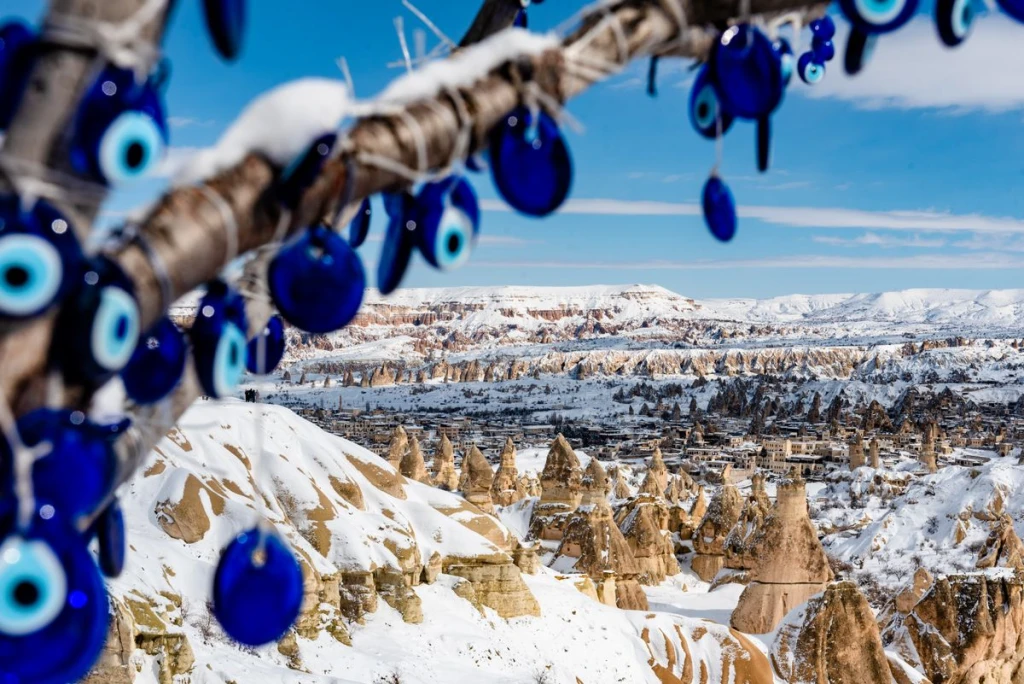
Cappadocia is the most searched domestic route for the semester break — for good reason. Fairy chimneys under snow look like nowhere else at any other time of year. Nevşehir’s deepest recorded snow depth (64 cm) also fell during a semester week, on 2 February 1992.
Cold has an upside: one of the region’s best-known stops is underground. Underground cities are far less affected by outdoor weather and stay comfortable to explore in winter. Rock churches and valley viewpoints look completely different with snow.
Two things to watch:
- Ground can be slippery. Valley walks and viewing terraces can ice over. Wear boots with grip or crampons, and pack spare socks and gloves for children.
- Mornings are freezing. The average January low is -3.5 °C. Dress in layers if you will be outside early.
Do balloons fly in winter?
Yes — but not every morning. In Cappadocia, balloons take off only when that morning’s conditions are cleared for flight; wind, fog or heavy snow cancel or delay flights. Winter cancellations can be more common. Put the balloon on the first morning of your stay so you still have a chance the next day if it is cancelled.
Families who skip flying, or decide it is not right for a child, can still watch balloons inflate and lift off from the ground — a lovely option in itself. ALYS’s Cappadocia standard balloon flight page lists hotel pick-up and drop-off, about one hour of flight at sunrise, a certificate, a light breakfast and a hot drink as included. Check details and age or health conditions on the tour page before you book.
How should you plan Cappadocia?
If you are based in Cappadocia, splitting the area into two day tours works well in winter because the days are short. The Cappadocia Red Tour runs about 09:30–16:00 and covers Uçhisar, Zelve, Paşabağ, Devrent and Avanos, with transfer, guide, lunch and museum entries included. The Green Tour covers Göreme panorama, Kaymaklı underground city and Ihlara Valley. Allow for icy ground if you plan the roughly 3 km Ihlara walk with young children in snow.
If you are on the Antalya coast, the 2-day Cappadocia trip from Side combines the region with an overnight stay. The page lists hotel pick-up and drop-off from Side, a licensed guide, underground-city entry, accommodation and dinner as included; the balloon, lunches and drinks are not. Return time can shift with traffic — build in extra buffer on winter roads.
Pamukkale: white terraces in the cold
In winter Pamukkale is clearly milder than Cappadocia: Denizli’s January daytime average is 10.7 °C. Hierapolis–Pamukkale, on the UNESCO World Heritage List since 1988, is open every day according to the Ministry of Culture and Tourism. Winter hours can be shorter, so check the current schedule on muze.gov.tr before you go.
The question people ask most in winter is about the water. The thermal spring that feeds the terraces is about 35 °C at the source, but the water cools as it spreads. You cannot walk the terraces in shoes, so cold, wet feet are the hard part in winter — bring a small towel and dry socks. The Antique Pool (Cleopatra’s Pool) needs a separate ticket and stays warm year-round, so it is popular in winter too. Snow is not guaranteed every year, but it does happen: on 1 January 2026 the terraces were covered in snow.
For travellers from the Antalya coast, the Pamukkale and Hierapolis day tour from Side is a long day: early hotel pick-up, a breakfast stop on the road, then free time at Hierapolis and the terraces. According to the page, lunch and dinner, an air-conditioned coach, a guide and insurance are included. Pamukkale/Hierapolis and Cleopatra Pool entries and drinks are not. Even though sunset in Pamukkale is after 18:00, part of the return is after dark. A pillow and snacks help with young children.
Antalya coast and Side: a mild base, snow in the mountains
If you want to explore a region from one base, the Antalya coast works well. January daytime averages sit around 15 °C. On MGM’s long-term data, Mediterranean sea temperature is 16.7 °C in January and 16.0 °C in February — chilly for swimming, ideal for beach walks.
The region’s winter quirk is that snow and sea can fit in the same day:
- Saklıkent Ski Centre: According to the Antalya Governor’s Office, the season runs from mid-December to early April depending on snow, with average snow depth of 100–200 cm. The 2026–2027 opening date has not been announced yet; check the centre’s notice before you go.
- Tahtalı Mountain cable car: Runs 09:00–15:00 from January to March. Services can change with weather. There is snow at the summit and a sea view below.
Remember: Antalya is the wettest region in the table in January. Some coastal hotels and seasonal businesses close in winter, so confirm that your accommodation is open for your dates. We cover what stays open in Side in winter and how the days feel in our Side in winter guide.
Another plus of basing on the Antalya coast: Cappadocia and Pamukkale can be added with tours that leave from here. You can spend part of the 16 days resting in mild weather and a few days seeing the snowy inland.
Istanbul and Bursa: a museum and city week
For families who do not mind rain and prefer indoor time, Istanbul–Bursa is a strong pair. Istanbul has the most rainy days in the table (about 16 in January on average), but museums, palaces and bazaars make it easy to build a weather-proof plan. On the Historic Peninsula, start early and see mosques and palaces before midday to use the short day well. Women need a head covering to enter mosques; keep a scarf with you.
Bursa is close enough for a day trip from Istanbul. The private Bursa day tour from Istanbul runs about 09:00–21:00 with hotel pick-up in Istanbul and a round-trip ferry from Yenikapı. The programme covers the Panorama 1326 museum, the İnkaya plane tree, the Grand Mosque, Osman Gazi’s tomb and Koza Han. Lunch and entrance fees are not included. Bursa is a little colder than Istanbul in January; the night-time average is 1.7 °C.
The end of the break meets the start of Ramadan
In 2027 the last days of the semester break overlap with Ramadan. On the Diyanet calendar, the first tarawih prayer is on the evening of Sunday 7 February, and the first day of fasting is Monday 8 February — the day schools reopen. For fasting families, that often means coming home on 6 February or early on the 7th: time to prepare the first suhoor at home, and a way to avoid the busy last-day return traffic.
Sample 16-day plans
These plans are only ideas. Adapt them to your city and your children’s ages.
- Snow-focused: 3–4 nights in Cappadocia (one Red Tour day, one Green Tour day; balloon on the first morning) + rest at home.
- Mild base + two inland routes: 7–10 nights on the Antalya coast. Add a Pamukkale day and a two-day Cappadocia trip; keep museums and hammams as indoor backups for rainy days.
- City and history: 4–5 nights in Istanbul + one day in Bursa, remaining days at home. Leave the last 2–3 days free for homework and getting ready for the second term.
What to wear and pack for the semester break
- Cappadocia: thermal base layers, fleece, coat, hat, gloves, scarf; waterproof boots with non-slip soles.
- Pamukkale: layered clothing, a small towel, spare dry socks, light flip-flops you can carry in a bag.
- Antalya coast: raincoat or umbrella, light jacket, walking shoes. Pack warmer layers if you plan the cable car or skiing.
- Istanbul–Bursa: waterproof shoes, umbrella, a scarf for mosques.
- Every route: ID documents (tours may ask for a copy of ID or passport), snacks for children, a portable phone charger.
Frequently asked questions
When does the 2027 semester break start and end?
On the MEB calendar, the mid-term break runs 25 January – 5 February 2027. Report cards are given on Friday 22 January; the second term starts on Monday 8 February. Including weekends, that is 16 days in total.
Where is the warmest place in Turkey during the semester break?
Among these four routes, the Antalya coast is the mildest: MGM’s average January high is 15.0 °C. It is also the wettest.
Does it snow in Cappadocia in winter?
Often, but not guaranteed. Nevşehir’s average January low is -3.5 °C, so snow that falls usually stays on the ground. Check the MGM forecast in the days before you travel for a firmer picture.
Do balloons fly in Cappadocia in winter?
They fly on mornings when conditions allow. Wind, fog or heavy snow cancel or delay flights. Cancellation risk is higher in winter, so schedule the balloon for your first morning.
Is Pamukkale’s water warm in winter?
At the source it is about 35 °C, but it cools as it spreads across the terraces. You walk the terraces barefoot; feet can get cold in winter. The Antique Pool stays warm year-round.
Can you swim in Antalya during the semester break?
The Mediterranean’s January average is 16.7 °C. People who cope well with cold can take a short dip, but for most visitors winter is a season for beach walks and sightseeing.
Does the 2027 semester break overlap with Ramadan?
Yes. The first tarawih is on the evening of 7 February; the first fast is Monday 8 February 2027 — the day schools reopen. Fasting families may want to return a day early.
Our partners