-
International Tours
Balkan ToursBalkan ToursRussia & Caucasus ToursRussia & Caucasus ToursMiddle East ToursMiddle East ToursFar East & Asia ToursFar East & Asia ToursAfrica ToursAfrica ToursAmericas & Oceania ToursAmericas & Oceania Tours


Cappadocia in December: Snow, Balloons, Weather and Tips
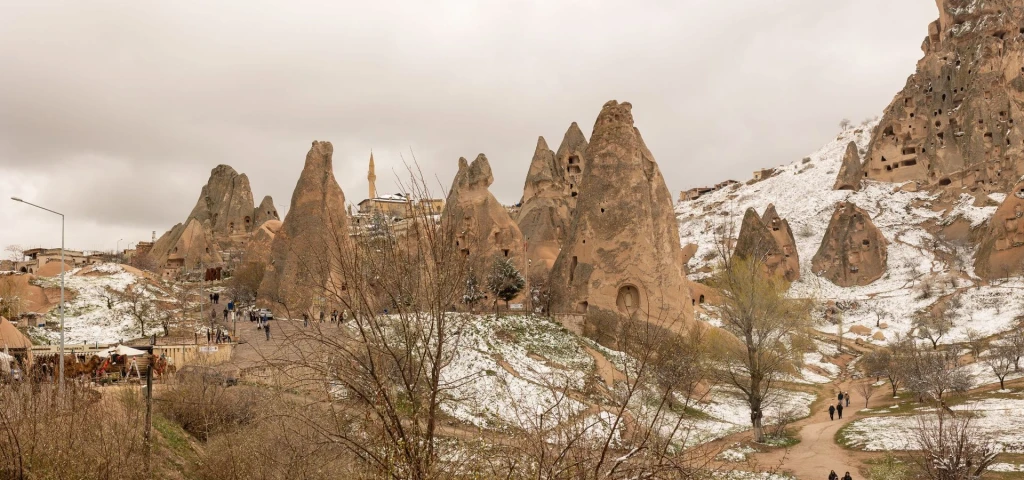
December is when Cappadocia changes character. The days are short and cold, the valleys are quiet, and on some mornings the fairy chimneys wake up under a layer of snow. It's also the month when balloon flights are hardest to predict. Here's what the weather actually looks like, how flight decisions are made each morning, and how to plan your days so one grounded morning doesn't spoil the trip.
Is Cappadocia worth visiting in December?
Yes, if you want a calmer Cappadocia and can let the weather decide some of your plans. You come for the winter landscape, the underground cities, the rock-cut churches and slow evenings indoors. It's the wrong month if your whole trip depends on one balloon flight squeezed into a single night. Give yourself three nights and December can be one of the most memorable times to go.
Cappadocia weather in December
Cappadocia is on the high plateau of central Türkiye, so winter here is a real winter, nothing like the Mediterranean coast. These are the official 1991–2020 averages for Nevşehir from Türkiye's State Meteorological Service, with November to February side by side:
MonthAverage highAverage lowDays with rain or snowSunshine per dayNovember | 11.6 °C | 2.1 °C | about 7 | 4.6 hours |
December | 6.2 °C | -1.4 °C | about 9 | 2.8 hours |
January | 4.1 °C | -3.5 °C | about 9 | 3.1 hours |
February | 6.0 °C | -2.6 °C | about 8 | 4.2 hours |
In practice, a December day usually means frost at dawn, a few degrees above zero by early afternoon, and a sharp drop again after sunset. Cold spells can go much further: the lowest December temperature on the station's record is -19.5 °C. Averages are a guide, not a forecast, and conditions change from valley to valley.
Does it snow in Cappadocia in December?
It can, but there's no guarantee. December gets about 48 mm of precipitation on average, spread over roughly nine days, and some of it falls as rain or sleet rather than snow. January is the coldest month of the year, and the deepest snow on Nevşehir's record, 64 cm, fell in February 1992. If a white landscape is the main reason for your trip, keep your dates flexible and watch the forecast in the week before you travel.
Short days, late sunrise
Türkiye stays on UTC+3 all year, so winter sunrises are late. In Göreme the sun rises at about 07:40 at the start of December and close to 08:00 by the end of the month, and it sets around 17:20. That leaves roughly nine and a half hours of daylight. Plan valley walks and viewpoints for the middle of the day, and keep indoor sights or a long dinner for the evening.
Do hot air balloons fly in December?
Yes. Balloons fly in every season, but only on mornings when the weather allows it, and in winter that happens less often.
Who decides if balloons fly
The decision isn't made by your hotel or the company you book with. Türkiye's civil aviation authority runs a slot service centre for the Cappadocia flying area, and every morning it publishes a flag for each flying sector:
- Red: conditions are unsuitable and no flights take place.
- Yellow: conditions are unsuitable for now but may change, so everyone waits for an update.
- Green: flights may go ahead, and the final decision rests with the pilot and the operator.
No balloon is cleared to take off under a red or yellow flag. The status page is public (shmkapadokya.kapadokya.edu.tr has an English version), so you can check it yourself at dawn.
What winter means in practice
Wind, fog, rain and snow are the usual reasons for cancellations, and in winter they can last several days. Turkish news reports described four cancelled mornings in a row in early December 2025, another four-day stretch at the end of that month, and 13 consecutive days without flights in February 2025. News agency reports put the region's average at around 220 flyable days a year. No one can tell you weeks ahead if your particular morning will fly.
How to plan your balloon flight
- Stay at least three nights. That gives you more than one possible morning.
- Book the flight for your first morning. If it's cancelled, you still have later mornings to try again, as long as there's space.
- Check the weather-cancellation terms when you book, and ask how a cancelled flight is handled on your dates.
- Expect a later start than in summer. The morning flying window opens 30 minutes before sunrise, so December flights start much later than summer's pre-dawn launches. Your exact pickup time is confirmed after booking.
- Dress for standing still in the cold. The basket is open, and the wait at the launch field before take-off can feel colder than the flight itself.
Our Cappadocia standard balloon flight includes hotel pickup and drop-off, a one-hour flight at sunrise, a light breakfast with hot drinks, a champagne celebration, a flight certificate and passenger insurance. For what happens from pickup to landing, see our Cappadocia hot air balloon sunrise flight guide.
Watching the balloons instead
If you'd rather stay on the ground, the Cappadocia balloon watching tour picks you up from your hotel before sunrise, takes you to a launch area to watch the balloons being inflated, then continues to the Love Valley viewpoint. It lasts about 1.5 to 2 hours and doesn't include a flight. One honest point: the same weather decision applies, so on a red-flag morning there are no balloons to watch either.
What to do on a winter day in Cappadocia
The good news is that a grounded morning doesn't leave you with nothing to do. Much of Cappadocia's history is underground or carved into rock, and some of it is more comfortable in winter than in summer.
Underground cities
Türkiye's Ministry of Culture and Tourism estimates there are 150 to 200 underground settlements in the region. Derinkuyu, opened to visitors in 1965, reaches a depth of about 85 metres, though only around a tenth of it can be visited. The ministry notes that underground cities stay cool in summer and relatively warm in winter, which makes them a good choice on a bitter day. Our Green Tour of Cappadocia includes an underground city, along with the Göreme panorama, Pigeon Valley, an onyx workshop, Ihlara Valley, lunch at a local restaurant and the Narlıgöl crater lake. The guide, transport, entrance fees and lunch are included. Paths in Ihlara Valley can be muddy or icy in winter, so wear boots with good grip.
Valleys, fairy chimneys and rock-cut villages
The Red Tour of Cappadocia covers the best-known fairy chimney landscapes in one day: Paşabağ (Monks Valley), the Zelve Open-Air Museum, Devrent (Imagination) Valley, Love Valley and the panoramic viewpoints at Uçhisar Castle, with a pottery workshop, a traditional lunch and a leather shop along the way. Hotel pickup in Cappadocia, an English-speaking guide, entrance fees and lunch are included. After fresh snow these valleys look their most dramatic, but the stops are outdoors, so bring layers.
Göreme Open-Air Museum
UNESCO inscribed Göreme National Park and the Rock Sites of Cappadocia on the World Heritage List in 1985. At the open-air museum, monks lived and worshipped in rock-cut churches and chapels from the 4th to the 13th century. The Dark Church gets its name from the small amount of light that enters it, and that's why its frescoes have kept their colours so well. Museums close earlier in winter, so check the current hours on the ministry's museum website (muze.gov.tr) before you go.
A simple three-night winter plan
- Day 1: arrive and settle in. Have an early dinner and an early night.
- Day 2: balloon flight at sunrise, then a rest and a short afternoon walk while it's light.
- Day 3: your backup balloon morning if needed, then the Red Tour.
- Day 4: the Green Tour or a slower morning before you leave.
Check day-tour pickup times when you book so they don't clash with a rescheduled balloon morning.
Coming from the coast in winter
If you're spending part of the winter in Side, our 2-day Cappadocia journey from Side includes hotel pickup and drop-off in Side, a licensed guide, the underground city entrance and one night's accommodation with dinner and breakfast. Lunches, the balloon flight and the Turkish Night show aren't included. It's a long drive inland over the Taurus Mountains, and winter roads can add time, so check availability for your dates in the booking calendar. With one night, you'll have one possible balloon morning, so stay longer if the flight is a must.
Flying in instead? Nevşehir Cappadocia Airport is about 40 km from the main hotel areas around Göreme, Uçhisar, Ürgüp and Avanos, roughly a 40 to 50 minute drive. Kayseri Airport is the other option, and we can arrange transfers from either.
What to pack for Cappadocia in December
- thermal base layers and a warm, windproof jacket
- waterproof shoes or boots with good grip for icy paths
- a hat, gloves and warm socks, especially for the balloon morning
- sunglasses for the glare when there's snow on the ground
- a power bank, because phone batteries drain faster in the cold
Frequently asked questions
Is Cappadocia worth visiting in December?
Yes, if you're happy with cold weather and some flexibility. You get quieter valleys, possible snow and comfortable indoor sights like the underground cities. Stay at least three nights if a balloon flight is on your list.
How cold is Cappadocia in December?
Official 1991–2020 averages for Nevşehir show a December high of about 6 °C and a low of about -1 °C. Mornings are often below freezing, and cold spells can bring much lower temperatures.
Does it snow in Cappadocia in December?
Snow is possible but not guaranteed. December has about nine days with rain or snow on average, and some of that falls as rain. Snow is possible from December to February, but snow cover is never certain on a particular date.
Do hot air balloons fly in December?
Yes, but only on mornings when the civil aviation authority's slot centre shows a green flag for the flying sector. Wind, fog and snow cancel flights more often in winter, so book your flight for the first morning of a stay of three nights or more.
What time do balloon flights start in December?
The morning flying window opens 30 minutes before sunrise, and December sunrise in Göreme is around 07:40 to 08:00. Pickups are much later than in summer, and your exact time is confirmed after booking.
What happens if my balloon flight is cancelled?
Cancellations are a safety decision based on the morning's weather, and nobody can override them. Check the weather-cancellation terms when you book, and plan a spare morning so you have a second chance.
What should I wear for a winter balloon flight?
Wear thermal layers, a warm jacket, a hat, gloves and closed shoes with grip. The wait at the launch field can be colder than the flight itself.
Our partners