-
International Tours
Balkan ToursBalkan ToursRussia & Caucasus ToursRussia & Caucasus ToursMiddle East ToursMiddle East ToursFar East & Asia ToursFar East & Asia ToursAfrica ToursAfrica ToursAmericas & Oceania ToursAmericas & Oceania Tours


Istanbul in December (and the Rest of Winter): An Honest Planning Guide
Istanbul in winter is grey more often than it is golden. It rains on roughly every second day, the wind off the Bosphorus has teeth, and the sun sets before most people finish their afternoon tea. It is also the season when you can stand in Topkapı's courtyards without a wall of tour groups, when every corner sells roasted chestnuts and hot salep, and when a ferry ride feels like a local commute rather than an attraction.
This guide is built on official numbers rather than guesses: the Turkish State Meteorological Service (MGM) statistics for Istanbul, the National Palaces' winter opening rules, and sunset times calculated for the city. Use it to decide whether December, January or February suits you, and how to shape your days if you go.
Is Istanbul worth visiting in December?
Yes, if you want the city's history, food and atmosphere more than sunshine. December and January are the months with the shortest queues at the big monuments, and most of Istanbul's best sights are indoors anyway: palaces, mosques, cisterns, museums, bazaars and hammams.
It is not the right month if you need reliable blue skies for photos, or if long outdoor walks are the main point of your trip. For winter sun, Turkey's Mediterranean coast is milder; for snow scenery, Cappadocia is the classic choice (see our Cappadocia in December guide).
Istanbul weather in December, January and February
These are MGM's long-term statistics for Istanbul (1950–2025 series):
MonthAverage highAverage lowMonthly averageDays with rainRainfallDecember | 11.8 °C | 6.5 °C | 9.0 °C | about 15–16 | 99 mm |
January | 9.6 °C | 4.2 °C | 6.8 °C | about 16 | 89 mm |
February | 10.2 °C | 4.2 °C | 6.9 °C | about 14 | 71 mm |
What this means on the ground:
- December is the wettest month by rainfall, but it is also the mildest of the three. Expect cool, damp days around 10–12 °C, with dry spells between fronts.
- January is the coldest. Daytime highs hover just under 10 °C, and the wind along the water makes it feel colder than the thermometer says.
- February is the driest of the three, but its cold snaps can be the sharpest: MGM's record low for February is −9.0 °C, against −4.2 °C for December and −6.8 °C for January.
Freezing days are the exception rather than the rule. The practical problem is wet and wind, not extreme cold.
Daylight: plan around a 17:30 sunset
Turkey stays on UTC+3 all year, so winter mornings are late and evenings come early. Approximate times for Istanbul:
DateSunriseSunset1 December | 08:09 | 17:37 |
15 December | 08:22 | 17:37 |
31 December | 08:29 | 17:45 |
15 January | 08:27 | 18:00 |
1 February | 08:15 | 18:21 |
28 February | 07:41 | 18:53 |
In December you get about nine and a half hours of daylight. A good rhythm is outdoor sights and viewpoints from late morning to mid-afternoon, then indoor plans, dinner or an evening cruise once it gets dark.
Palace winter hours and closing days
This is the detail most winter guides skip, and it can cost you half a day.
- From 13 October 2026, the ticket offices of the National Palaces (including Topkapı Palace, Dolmabahçe Palace, Yıldız Palace and Beylerbeyi Palace) close at 17:00 for the winter season.
- Topkapı Palace is closed on Tuesdays.
- Dolmabahçe, Beylerbeyi and most other palaces and pavilions are closed on Mondays. Yıldız Palace closes on Wednesdays.
- Dolmabahçe Palace is closed on New Year's Day (1 January).
So: don't plan Topkapı for a Tuesday or Dolmabahçe for a Monday, and aim to arrive by early afternoon. With sunset around 17:30, a palace visit is best followed by something indoors.
A rain-proof winter day in Istanbul
Most of the old city works in the rain if you string the stops together sensibly:
- Morning: Hagia Sophia and the Blue Mosque (bring a scarf for mosque visits; women need to cover their hair), then the Basilica Cistern, which feels the same whatever the weather.
- Midday: Topkapı Palace's treasury and harem rooms, or the Istanbul Archaeology Museums next door.
- Afternoon: The Grand Bazaar (closed on Sundays) and the streets down towards the Spice Bazaar, with a stop for tea or salep.
- Evening: A hammam, a meyhane dinner, or a Bosphorus dinner cruise.
If you'd rather not juggle trams, taxis and rain, our private Istanbul tour with driver is an 8-hour day with a chauffeur and a guide that covers Hagia Sophia, Topkapı, the Blue Mosque, the Grand Bazaar, a Bosphorus drive and Dolmabahçe. Museum entrances aren't included, and in winter it's worth choosing your day around the palace closing days above. More ideas are on our Istanbul tours page.
The Bosphorus in winter
The Bosphorus is at its moodiest in winter: low cloud over the hills, steam rising from tea glasses on the ferry, seagulls following the boat. Public ferries keep running all year, though strong winds can occasionally disrupt crossings, so keep a little slack in your plans.
After dark, a dinner cruise is a warm way to see the palaces, bridges and Maiden's Tower lit up. Our Bosphorus dinner cruise includes hotel pick-up and drop-off, a set menu of mezes and a main course, unlimited soft drinks, and a show with folk dances, a whirling dervish performance and belly dancing. Our Bosphorus dinner cruise guide explains what the evening is like.
Snow in Istanbul
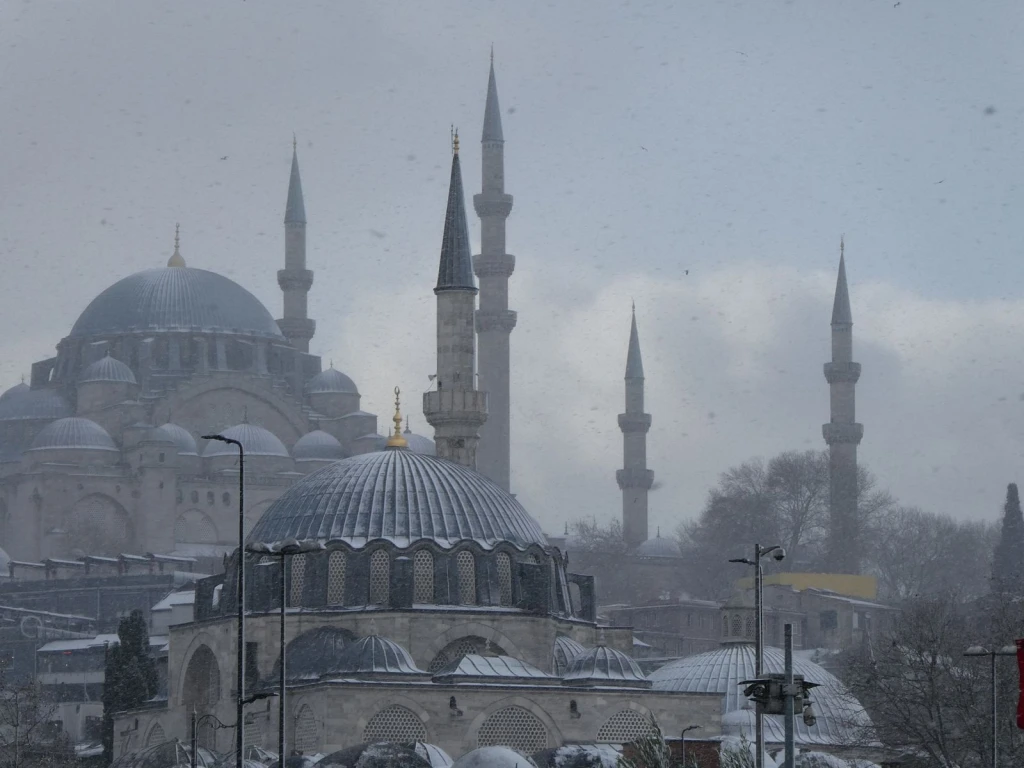
Snow does fall in Istanbul most winters, but usually in short spells rather than a white season, and it rarely lasts long in the centre. January and February are the likeliest months. When it does arrive, the city can be beautiful, with the domes of Süleymaniye and Hagia Sophia under white, but it can also slow traffic and ferries for a day. The deepest snow cover MGM has on record for Istanbul is 41 cm, measured in March 1987, which shows that the biggest falls are rare events.
Don't plan a trip around seeing snow in Istanbul. Treat it as a bonus.
New Year in Istanbul
New Year's Eve is the busiest night of the winter. Fireworks over the Bosphorus draw crowds to the waterfront, and restaurants, hotels and cruises run special evenings that fill up early. 1 January is a public holiday in Turkey, and in 2027 it falls on a Friday, which makes for a long weekend and busier streets. Some sights close on New Year's Day (Dolmabahçe Palace is one), so check before you go.
If you're comparing Christmas and New Year destinations around Turkey, see our Christmas in Turkey guide.
A winter day trip: Bursa
Bursa, the first Ottoman capital, makes a good winter escape, because most of its highlights are covered or compact. Our private Bursa day tour from Istanbul runs from 09:00 to 21:00 with hotel pick-up, the ferry from Yenikapı and a private Mercedes Vito or Sprinter. It visits the Panorama 1326 museum, the 600-year-old İnkaya plane tree, the Grand Mosque (Ulu Cami), the tomb of Osman Gazi and the silk market at Koza Han, with a stop for İskender kebab (lunch not included). Our Bursa day trip guide covers the ferry and timing in more detail.
Since it's a 12-hour day, choose a dry forecast if you can. Part of the return is after dark.
Getting in from the airport
Winter arrivals often land after sunset, sometimes in rain, and that is when a pre-arranged ride helps most. We arrange private Istanbul Airport transfers with meet-and-greet in an air-conditioned vehicle. Send us your flight details and hotel address, and we'll come back to you with an offer before anything is confirmed.
What to wear
- A waterproof, windproof jacket matters more than a heavy coat.
- Layers: a warm jumper or fleece under the jacket, since museums and trams are heated.
- Shoes with grip and some water resistance. Sultanahmet's stone streets get slippery.
- A compact umbrella, gloves and a scarf. The scarf also covers your hair in mosques.
- Expect to take your shoes off in mosques, so warm socks help.
FAQ
Is Istanbul worth visiting in December?
Yes, if you're happy with cool, often rainy weather in exchange for short queues and a local feel. Most of the major sights are indoors.
How cold is Istanbul in December?
MGM's long-term average high is 11.8 °C and the average low 6.5 °C. Wind and damp can make it feel colder.
Which is the coldest month in Istanbul?
January, with an average monthly temperature of 6.8 °C. February is almost as cold and has the lowest recorded temperature of the three winter months.
Does it snow in Istanbul in winter?
Usually a few times a winter, mainly in January and February, but snow rarely lasts in the city centre.
What time does it get dark in Istanbul in December?
Around 17:35–17:45 all month. By the end of February sunset is closer to 19:00.
Are Topkapı Palace and Dolmabahçe Palace open in winter?
Yes. Their ticket offices close at 17:00 in the winter season. Topkapı is closed on Tuesdays, and Dolmabahçe on Mondays and on 1 January.
Is the Bosphorus worth it in winter?
Yes. Ferries run all year, and an evening dinner cruise lets you see the lit-up shoreline from the water.
Is January or February better for Istanbul?
February is slightly drier and the days are noticeably longer by the end of the month, while January tends to be the quietest time for sightseeing.
Our partners