


Aspendos Theatre: A Practical Visitor Guide from Side, Belek and Antalya
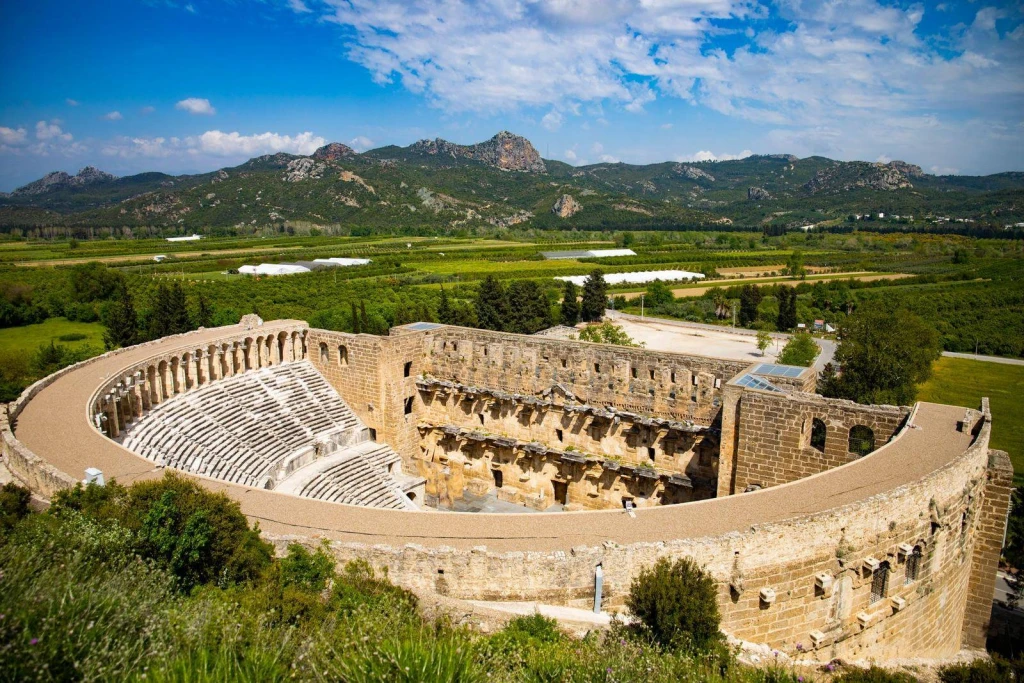
Many people on the Antalya coast see Aspendos only at an evening show, when the stage is lit and the rest of the site is dark. That is a good night out. But Aspendos is worth a daytime visit of its own, and the site is open every day, winter included.
This guide covers what you will actually see, how long the drive is from the main resorts, when the gates open and close, and what is easy to miss once you have taken your photo of the stage. Opening hours and site details below were checked on the official Ministry of Culture and Tourism page on 19 November 2026.
Aspendos at a glance
Where | Belkıs, Serik district, Antalya province |
Opening hours (checked 19 Nov 2026) | 08:00–17:00, ticket office closes 16:30 |
Closed days | None, open every day |
Audio guide | Available on site |
Built | 2nd century AD, architect Zenon |
UNESCO | On Türkiye's Tentative List since 2015 (theatre and aqueducts) |
By road from Side old town | About 35 km |
By road from Belek | About 18 km |
By road from Antalya Airport | About 40 km |
Hours change with the season, so check the official page (muze.gov.tr, "Aspendos Archaeological Site") on the day you plan to go.
Why this theatre looks almost new
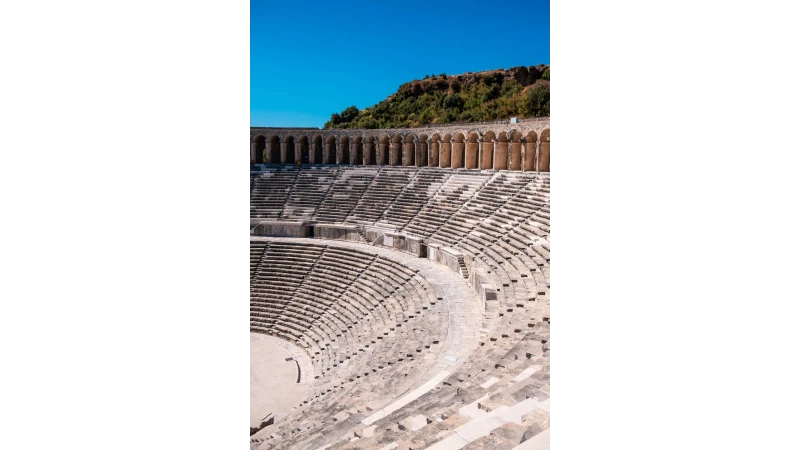 Plenty of Roman theatres survive in Türkiye. What makes Aspendos different is the stage building. In many ancient theatres the tall wall behind the stage has collapsed, leaving a bowl of seats facing an open view. At Aspendos it is still standing to its full height, so the theatre feels enclosed, the way it was meant to.
The theatre was built in the 2nd century AD by the architect Zenon, son of Theodoros. Greek and Latin inscriptions at the entrances name the two wealthy brothers who paid for it, Curtius Crispinus and Curtius Auspicatus, and dedicate it to the gods and the imperial house.
It survived largely because it was reused. In the 13th century the Seljuks repaired the building and used the stage building as a palace or caravanserai. You can still see their work if you know where to look: the monumental doorway added to the middle of the outer façade, and patches of dark red plaster painted with a zigzag pattern. UNESCO's description of the site also mentions traces of geometric designs and blue tiles from that period. In 1930 Atatürk visited and ordered that the theatre be repaired and used again. Today it still hosts concerts and performances.
How many people does it hold? Official sources do not agree. The Ministry's Turkish page says about 12,000, its English page says 15,000, and the Ministry's Culture Portal says 15,000 to 20,000. For modern shows the seating is much smaller: the Fire of Anatolia evenings list a capacity of 4,700.
One small thing to try: the Ministry's own text repeats the old claim that a coin dropped on the stage can be heard from the top rows. On a quiet morning you can try it yourself.
Don't stop at the stage: the upper city and the aqueduct
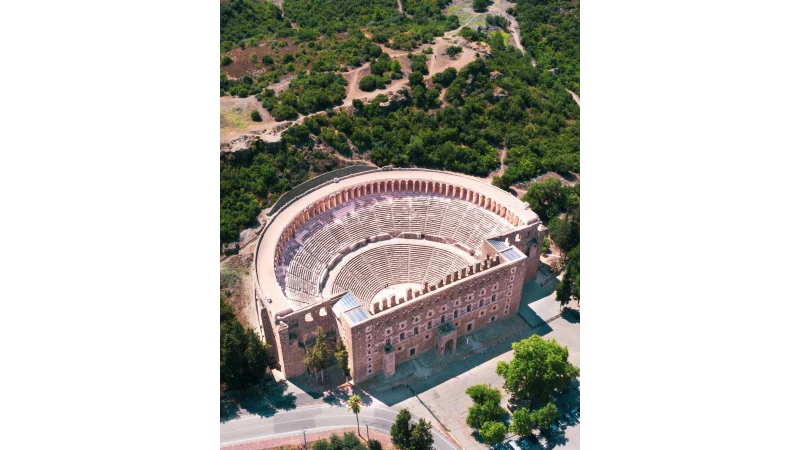 It is easy to see only the theatre and leave. The rest of the ancient city sits on the flat-topped hill behind it, and it is worth the climb.
According to the Ministry, the city had two parts. The theatre and a stadium are in the lower city. On the hill are the agora, a basilica about 100 metres long, a monumental fountain 35 metres long and 15 metres high, and the odeon behind it. The Culture Portal also lists a council building, a monumental arch, a street and a Hellenistic temple. Parts of the hill are ringed by city walls.
The aqueduct is the other reason to come. It is a line of arches roughly a kilometre long, running north to south, with a water pressure tower at each end. The Ministry describes it as bringing water to the acropolis from mountains about 25 km north-west of the city, and the Culture Portal calls the system one of the best-preserved ancient water systems to survive. UNESCO's Tentative List entry names the theatre and the aqueducts together.
Practical note: the aqueduct lies to the north of the city hill, so allow extra time and wear shoes you can walk in on uneven ground.
The Seljuk bridge on the Köprüçay
About 2 km south of the acropolis, the old road crosses the Köprüçay river (the ancient Eurymedon) on a stone bridge. The Culture Portal records that it was built in 1239–1240 for the Seljuk sultan Gıyaseddin Keyhüsrev II, son of Alaeddin Keykubad I. It stands on the foundations of an earlier Roman bridge, which is why its line is not straight. Antalya's cultural inventory describes seven pointed arches.
It makes a good five-minute stop on the way in or out, and it explains why Aspendos was here at all. In Roman times the river connected the city to the sea and carried its trade. The same river, much further upstream, runs through Köprülü Canyon National Park, where our Köprülü Canyon rafting day from Side takes place on a section of the Köprüçay.
Getting there
Aspendos sits a little inland from the main road between Antalya and Manavgat. Road distances to the site, measured with an open routing service on 19 November 2026:
From Distance by road Drive without traffic Belek | 17.5 km | about 20 minutes |
Side old town | 34.5 km | about 30–35 minutes |
Manavgat | 35 km | about 30 minutes |
Perge | 34 km | about 30 minutes |
Antalya Airport | 40 km | about 35–40 minutes |
Antalya old town (Kaleiçi) | 48 km | about 45 minutes |
Alanya | 94 km | about 1 hour 15 minutes |
Summer traffic on the coast road can add a lot to these times.
If you are driving, Aspendos pairs naturally with Perge, which is about 34 km to the west on the Antalya side. Without a car, the Culture Portal notes that local minibuses (dolmuş) run to Aspendos from Serik. A taxi from the resorts is the other option. For a broader look at combining sites in one day, see our guide to Perge, Aspendos and Alanya as day trips from Side.
When to go: summer heat or a winter morning
Most of the visit is outdoors on open stone, and summer on this coast is hot. Long-term averages from Türkiye's State Meteorological Service (MGM) for Antalya:
Month Average high Average low Rainy days January | 15.0 °C | 5.9 °C | 12.6 |
March | 18.4 °C | 8.3 °C | 9.6 |
May | 26.4 °C | 15.7 °C | 7.1 |
July | 34.9 °C | 23.4 °C | 1.2 |
August | 34.9 °C | 23.7 °C | 0.7 |
October | 27.3 °C | 15.9 °C | 6.2 |
December | 16.7 °C | 7.5 °C | 12.4 |
In July and August, go when the gates open or late in the afternoon, and take water. From November to February the temperatures are comfortable for walking, but rain is more frequent, and December is the wettest month of the year in Antalya by MGM's figures. Pick a dry day and check the forecast the night before.
In winter you will not watch the sunset from the tiers. On 15 December the sun sets at about 17:39 at Aspendos, after the 17:00 closing time. Arrive by early afternoon so you are inside well before the ticket office closes at 16:30.
If you are planning a winter stay on the coast, our Antalya in winter guide covers weather and other things to do in the same months.
Seeing a show in the theatre
Aspendos is one of the very few ancient theatres where you can still sit through a full performance. Two kinds of evening are worth knowing about.
The Aspendos International Opera and Ballet Festival. This is organised by the State Opera and Ballet, part of the Ministry of Culture and Tourism. The 33rd festival ran from 12 to 26 September 2026, with six performances of four works (Attila, Anna Karenina, Carmina Burana and Spartacus). All of them started at 21:00. Look for the 2027 programme on the State Opera and Ballet website and the Ministry's Culture Portal.
Fire of Anatolia. This dance company performs at Aspendos in the warmer months. The show season usually runs roughly from May to October; bookable dates are shown on the tour page, so check the calendar for exact dates. Our Fire of Anatolia evening with hotel transfers includes hotel pick-up and drop-off and the show ticket; drinks are not included. Before you choose a date, read our Fire of Anatolia at Aspendos guide for seating tips and how the season works.
At night your attention is on the stage, and you see little of the building. That is the best argument for coming back in daylight.
Tickets and practical tips
- Tickets. Buy at the site or through the Ministry's e-ticket system on muze.gov.tr. Aspendos is included in the Ministry's MuseumPass The Mediterranean. If you are visiting several sites in one week, our Turkey museum pass and entrance fees guide helps you work out whether a pass is worth it.
- Audio guide. The Ministry lists an audio guide service at Aspendos. Under the official 2027 fee list, the electronic audio guide is included in the foreign visitor ticket.
- Turkish citizens. The MüzeKart is valid here.
- Shoes. The tiers are original stone and the steps are steep. Wear shoes with grip, and hold the handrail on the way down.
- Water and sun. Bring water in any season. In summer, add a hat and sunscreen.
- Timing. Allow at least an hour for the theatre on its own. Add another hour or so if you want to climb the hill to the upper city and walk out to see the aqueduct.
Frequently asked questions
Is Aspendos worth visiting? Yes, especially if you have only seen it at night. It has what the Ministry of Culture and Tourism calls the best-preserved Roman theatre in Türkiye, with its stage building still standing to full height. Add the aqueduct and the Seljuk bridge, and it makes a full half-day.
Is Aspendos open in winter? Yes. When we checked the official page on 19 November 2026, Aspendos was open every day from 08:00 to 17:00, with the ticket office closing at 16:30. Hours can change by season, so check before you go.
How far is Aspendos from Side? About 35 km by road from Side old town, a drive of around half an hour without traffic. From Belek it is about 18 km, and from Antalya Airport about 40 km.
How many people did the Aspendos theatre hold? Official figures range from about 12,000 to 20,000, depending on the source. Modern performances use far fewer seats; the Fire of Anatolia shows list 4,700.
Is Aspendos a UNESCO World Heritage Site? Not yet. "The Theatre and Aqueducts of the Ancient City of Aspendos" has been on Türkiye's UNESCO Tentative List since 13 April 2015. That is the step before a full nomination.
Can you still watch performances at Aspendos? Yes. The Aspendos International Opera and Ballet Festival is held there (12–26 September in 2026), and the Fire of Anatolia dance company performs there in the warmer months. Fire of Anatolia does not perform in winter.